When someone asks how you feel, your honest answer is often I don’t know. Not evasion. Genuine blankness. The signal that tells most people what they’re feeling, why they’re feeling it, and what to do with it either doesn’t arrive — or arrives as static.
You describe emotional events in terms of facts. You watch your own life with a kind of detached clarity. You remember what happened in a significant moment but not how it felt. People who love you have called you cold, distant, robotic. None of those words fit the inside.
There is a name for this. The name is alexithymia.
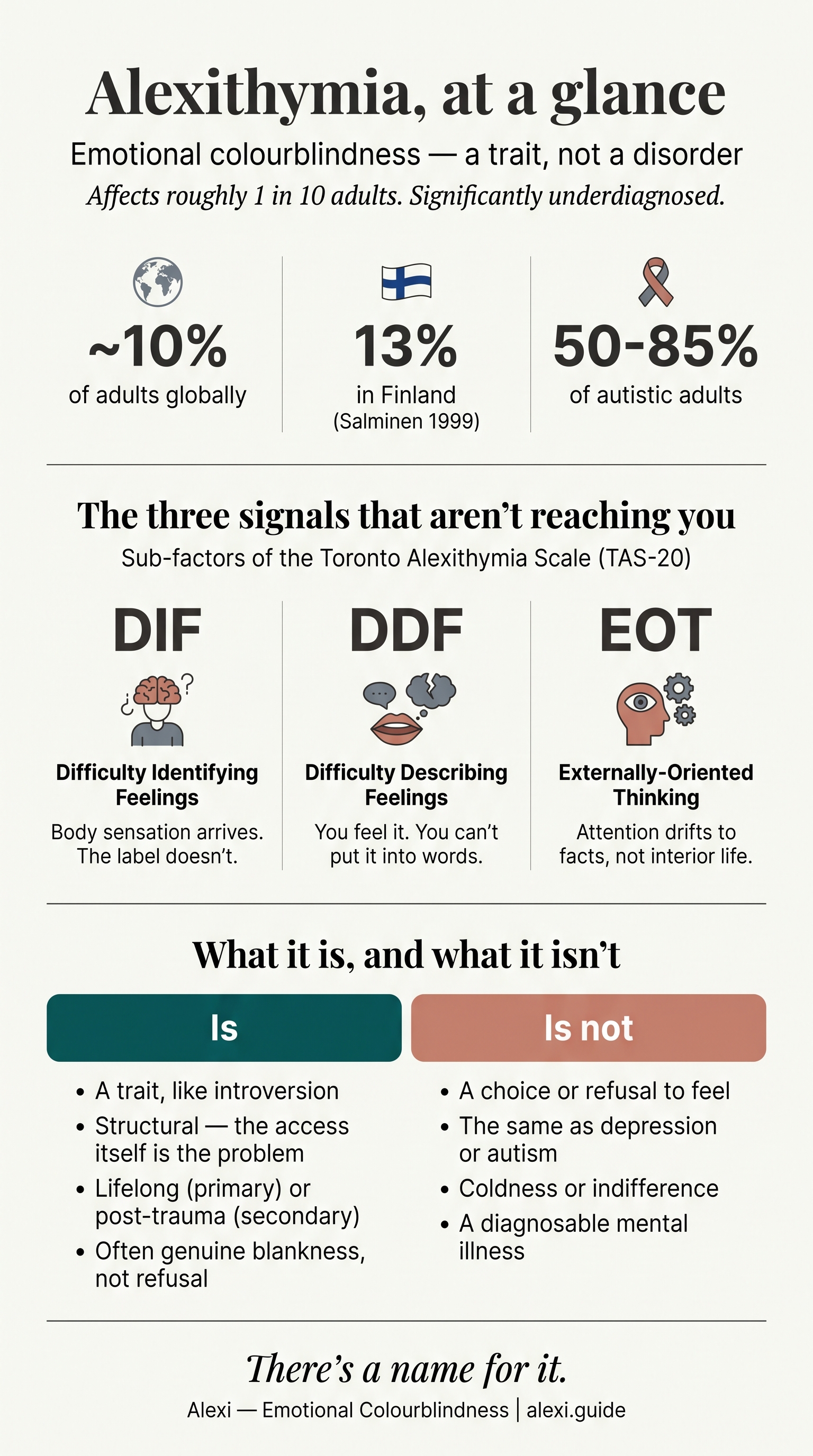
It is not a disorder. It is not depression. It is not a deficit in caring. It is a trait — like introversion — present in roughly one in ten adults and significantly underdiagnosed. Someone who is colourblind is not blind; the world is real, the shapes and movement and depth are all there, but a dimension of visual information that others take for granted simply does not register. Emotional colourblindness works the same way. The feelings are there. The readout is not.
This article names the trait, describes what it actually feels like from the inside, walks through the three signals it disrupts, and points to where to go next — including how it is distinguished from depression and autism, how common it actually is around the world, and what the first practical steps look like if any of this is starting to sound like the shape of your inner life.
This article is informational, not a diagnosis.
What alexithymia actually is (and isn’t)
Neither the DSM-5 nor the ICD-11 lists alexithymia as a mental disorder. That is the first thing worth saying out loud, because almost every popular write-up gets this wrong by accident — calling it a “condition”, a “phenomenon”, a “deficit” — and the language quietly does the pathologising the diagnostic manuals refuse to do. The reframe is not cosmetic. Calling a stable personality dimension a “condition” is the same kind of mistake as calling introversion an illness, and the cost is borne by the people doing the reading.
The term itself was coined in 1972 by the Harvard psychiatrist Peter Sifneos, from the Greek for “no words for feelings”. For the first decade or so it lived inside psychosomatic medicine — a curiosity used to describe patients who somatised emotion rather than naming it. Then, in the early 1990s, Bagby, Taylor, and Parker built the Toronto Alexithymia Scale (the TAS-20), and the construct moved from clinical curiosity into measurable personality dimension. The scale has since been used in tens of thousands of studies across dozens of languages, and the alexithymia meaning that emerges from that body of work is consistent: a stable trait that varies along a spectrum, captured with self-report measures, present at all ages, in all populations, in all countries that have been studied.
Salminen and colleagues’ Finnish general-population work in the late 1990s set the most-cited prevalence figure at around 13%, and the number has held up across replications. Other countries land higher, others lower. None land at zero.
The modern view: a trait, not a disorder. Like introversion. Affects roughly one in ten people, with notable variation by country and by population — the global picture is its own essay. Significantly underdiagnosed because the people who have it are, almost by definition, the last to be able to describe it.
The Perth Alexithymia Questionnaire (Preece and colleagues, 2018) and the older Bermond-Vorst Alexithymia Questionnaire round out the toolkit. None of them produce a binary label. They produce a position on a spectrum — high, moderate, low — and from there, recognition does most of the rest of the work.
What it feels like from the inside
Your partner asks what’s wrong. You search inside, the way you have learned to search, and there is nothing there to report. Not nothing as in I’m fine, performed. Nothing as in genuine static where a signal should be.
You describe the day in terms of what happened. The meeting ran long. The drive home was slow. The dishes were stacked when you got in. Asked how any of it landed, you produce another fact — it was a long day — because the layer underneath, the felt layer, is not available for retrieval. You know something is happening in your body. You can feel the tightness in your shoulders, the restlessness in your legs, the dull press behind your eyes. None of these arrive with labels attached.
You can watch your own life with a kind of detached clarity, as if observing rather than participating. Significant moments — a wedding, a funeral, a breakup — are stored as scenes, not as feelings. You remember the room, the words, the weather. You do not remember how it felt because nothing was filed there.
You learn to prepare answers in advance. At the dinner party, when the friend you have not seen in a year asks how you have been, you produce the stock answer you assembled on the drive over — busy, the kids are good, work is steady — because the real answer would require an introspective lookup that does not return results in real time. The stock answer is not a lie. It is the closest thing to true that is reachable inside the social tempo of the question. The asking gets faster than the looking-up, and over years you become very good at the trick of sounding answered.
Other people have called this cold. They have called it distant, robotic, evasive, withholding. None of those words match the inside. The inside is more like working with one fewer instrument than the rest of the orchestra — you play the notes you have access to, you play them carefully, and you spend a lot of energy trying to fake the part you cannot hear. The fakery is exhausting. Most adults with alexithymia describe it as the single most tiring social cost of the trait.
These are the textures most readers recognise: the blank-not-evasion answer; the body-first ordering, where sensation always arrives before language, often without language ever following; the years of being read as someone you are not. Signs of alexithymia rarely look dramatic from outside. They look like a slightly delayed reaction, a slightly wooden phrasing, a slightly off-tempo response to news. From inside, they feel like translating in real time from a language you were never quite taught.
This is not absence of feeling. It is absence of the readout.
The three signals that aren’t reaching you: DIF, DDF, and EOT
There are three places the signal can fail, and most well-validated assessments measure all three.
DIF — difficulty identifying feelings. The body sends something. Tension, fatigue, restlessness, a low hum of something that might be sadness or might be hunger or might be tiredness. The sensation is unmistakable; the label is not. The classic question — how do you feel right now? — returns null where another person’s mind would return anxious, a little embarrassed, mostly tired. You know something is happening. You cannot say what.
DDF — difficulty describing feelings. Sometimes a label is reachable — you suspect it might be anger, or grief, or relief — but putting it into words for another person feels like translating from a half-known language. The vocabulary either won’t come, or comes wrong, or arrives in clinical terms — dysregulated, activated, low affect — that don’t match the texture of the experience. A partner asks you to elaborate, and the elaboration costs you ten minutes of internal scaffolding for thirty seconds of speech. By the time you have the words, the moment they were meant for has passed.
EOT — externally oriented thinking. Attention runs outward, toward facts, plans, tasks, the weather, the news, what happened next, what needs doing. The inward question — how do I feel about this? — registers as either uninteresting or unanswerable, and quietly stops being asked. EOT is the one most often mistaken, by partners and therapists alike, for emotional avoidance. It is rarely avoidance. It is more like the question simply does not produce useful results, so the mind has learned to skip it. The look that gets read as evasion is, more often, a kind of polite confusion at the question.
The TAS-20, built by Bagby, Taylor, and Parker, measures all three sub-factors. It is the most-cited instrument in the field, used in tens of thousands of studies. It also has a known weakness: the DIF subscale tends to be inflated by general distress, which is why Preece and colleagues developed the Perth Alexithymia Questionnaire to separate trait from state more cleanly. Both are useful. Neither produces a verdict; both produce a position.
Most readers find they recognise themselves more strongly in one or two of these alexithymia traits than in all three equally. That is normal and consistent with what the research shows — the three sub-factors are correlated but not identical, and a high DIF with moderate EOT looks different, lived from inside, than a high EOT with moderate DIF. The shape of your particular profile is one of the more useful things a self-assessment can give you.
Type I, Type II, and primary versus secondary
Two further distinctions are worth knowing, because they shape how the trait shows up and what you can do with it.
The first is Type I versus Type II, drawn from the work of Bermond, Vorst, and colleagues. Type I alexithymia describes those whose emotional experience itself is muted — both the affective signal and the cognitive labelling are reduced, and the inner landscape is genuinely flatter than most people’s. Type II alexithymia describes those whose affective experience is intact but whose cognitive access to it is impaired — the feelings are happening, but the route from feeling to thought to language is blocked. The Bermond-Vorst Alexithymia Questionnaire was designed precisely to capture this distinction; the TAS-20 does not separate the two.
The second is primary versus secondary. Primary alexithymia is the lifelong trait — present from childhood, with neurodevelopmental and likely partly genetic contributions, stable across the adult lifespan. Secondary alexithymia is the response form, arising after trauma, chronic illness, or sustained stress, and often remitting as the underlying condition resolves. A third category, organic alexithymia, is reserved for cases tied to specific neurological events: stroke, traumatic brain injury, certain neurodegenerative conditions, where the trait emerges with the medical event and tracks its course.
The two distinctions are independent. You can be primary Type II — born with the trait, capable of feeling, unable to translate. You can be secondary Type I — affect itself muted in the wake of something the body needed to mute. The combination shapes the texture of the experience, but it does not change the basic reframe: the trait is structural, not a flaw of character.
For most readers arriving at this article, the practical question is not which subtype, but whether what they are describing is the lifelong shape of their inner world or a more recent compression of it. Both answers point to different next steps. A primary, lifelong trait calls for vocabulary and patience. A secondary, recent compression calls for attention to the underlying cause first. Neither answer is a sentence.
Why “I don’t feel anything” is not the same as depression, autism, or detachment
Depression turns the volume of feeling down. Alexithymia leaves the volume where it is — but cuts the readout.
That distinction matters because the search query “I don’t feel anything” pulls in three quite different experiences, and getting the right name attached changes everything that follows.
Depression dampens. The signal that should be loud — joy at a friend’s good news, sadness at a loss, fear before a deadline — comes through quietly or not at all, and the dampening is part of the illness. Alexithymia does not dampen the signal in the same way. It mutes the label. Many people live with both, and the texture of the two together is different from either on its own — a low, flat baseline (depression) overlaid on a missing translator (alexithymia). If recognising yourself here is sliding toward something darker, the crisis-line numbers at the close of this article are the right starting point.
Dissociation is a stepping-back from experience, often trauma-driven. Alexithymia is not stepping back. You are present, you are participating, you are in the room — you simply cannot translate what you are present to.
Autism is a different neurotype with substantial overlap. Depending on the sample, between half and 85% of autistic adults score above the alexithymia cutoff on the TAS-20 — but the two are dissociable. Shah and colleagues’ 2016 work suggested that the interoceptive differences often attributed to autism actually track alexithymia, not autism per se: you can be autistic without being alexithymic, and you can be alexithymic without being autistic, and the overlap is large but not total. The neurodivergent overlap deserves a separate look.
Emotional unavailability and dismissive-avoidant attachment are the fourth confound, particularly for partner-perspective readers. These are patterns of declining to share feeling — the access is there, the willingness is not. Alexithymia is the inverse: the willingness is usually present, the access is what fails. The two get conflated in relationship advice columns all the time, and getting the distinction right changes the advice almost entirely.
Each of these can co-occur. Untangling them is what a careful clinician — or a careful self-audit — does, slowly. Is alexithymia a disorder? No. Is it the same as emotional blindness or any of these adjacent experiences? Also no. It sits beside them, sometimes overlapping, never identical.
How common is it, really?
Roughly one in ten adults score above the standard cutoff on the TAS-20. The figure varies by country more than most readers expect, and it varies by population even more.
The most-cited general-adult prevalence comes from Salminen and colleagues’ Finnish study: 13% overall, with men at 17% and women at 10%. The gender skew is consistent across most population studies — Levant’s framing of “normative male alexithymia” attributes part of this to socialisation, where boys raised to suppress emotional expression score higher on DDF and EOT in particular. Iranian university student samples have been reported between 21.8% and 43.8% across different studies. Chinese prison samples have come in at 31.4%. Saudi medical student cohorts were studied in 2022 with elevated rates as well. Asian-heritage samples consistently score higher than European-heritage samples on the TAS-20, and the cross-cultural research (Dere, Ryder, Chentsova-Dutton) suggests this is partly mediated by collectivist emotional-restraint norms — by what cultures teach about expressing inner states — rather than by anything biological.
Two more figures worth knowing. A 2025 Springer meta-analysis of student populations reported a jump from 18.4% pre-pandemic to 28.3% during COVID, consistent with secondary alexithymia rising under sustained stress; a separate global meta-analysis put student prevalence at 23.6% across 17 studies and just over eleven thousand participants. And across populations with overlapping conditions: roughly 50–85% of autistic adults, 22–44% of adults with ADHD, around 42% of those with PTSD, 37% in cancer cohorts, and elevated rates in alcohol-use and other substance-use disorders.
Prevalence is not destiny, and these figures are not your verdict. They are background. Whatever the country and whatever the population, if you are an adult with alexithymia you are part of a group of millions of others — likely a much larger group than the figures suggest, given the underdiagnosis the trait creates by its own definition. The full picture, country by country, lives in the worldwide explainer.
What it isn’t: the “cold and uncaring” misreading
Cold. Distant. Robotic. Uncaring. The vocabulary the world uses for alexithymia rarely matches what the trait actually is.
The misreading happens because emotional expression is read as emotional experience — and when the expression is missing or muted, the experience is assumed to be missing or muted with it. It usually isn’t. Affection, loyalty, grief, attachment, care: these can all be present without the reflexive facial cues, the conversational warmth, the verbal naming that signal them to other people. The signal is internal. What the partner sees is the report. When the report is blank, the partner reads “indifference” — and the alexithymic person, looking inside, finds the affection where they expected to and is left baffled at being misunderstood again.
The misreading also compounds. Year by year, the alexithymic adult learns to mistrust their own internal report, because too many people have told them that what they say they feel cannot be what they actually feel. The result is a strange double-blindness: a trait that was already hard to translate, narrated by an inner voice that has been taught not to trust its own translations. Recognition undoes some of this. Naming the trait is the first step in trusting the report again.
If you are reading this for someone you love rather than for yourself — a partner, a parent, an adult child — the blank answer to “how do you feel?” is almost never indifference. It is the static a colourblind person sees where you see a colour. It is the missing instrument, not a missing care. The asymmetry is real, and learning to read past the missing report toward the present-but-unreadable feeling is most of the work of loving someone alexithymic.
For the alexithymic reader, the misreading has likely cost you years. Honesty about the trait does more for connection than performing emotions you do not have access to. Saying “I don’t have a label for this yet, but you matter to me and I am here” is more accurate than any of the lines you might be tempted to reach for, and over time it builds something more durable than a performance ever could.
Where to start if this sounds like you
Recognition is the first intervention. If any of this is starting to sound familiar, here are three light starting points — none of them require therapy, a diagnosis, or a major life rearrangement.
Take a measured self-assessment. The TAS-20, the Perth Alexithymia Questionnaire, and the Online Alexithymia Questionnaire are all freely available, well-established, and short enough to complete in fifteen minutes. They will not tell you who you are. They will tell you where you sit on a spectrum, and they will give you a vocabulary for the part of yourself you have been describing in negatives. A short companion piece walks through which test does what and how to read the score.
Start a body-first vocabulary. Most alexithymic adults can name a sensation — tight chest, restless legs, clenched jaw, dull weight behind the eyes — well before they can name a feeling. Working in that order, sensation first and candidate label second, is more effective than “try harder to feel”. The label may come hours later, or days later, or as a quiet recognition the next time you encounter the same sensation. That is not failure. That is the trait, working at its own speed.
Read about the trait, not the cure. There is no cure for a trait that is not an illness. There is, however, a difference between living with alexithymia in the dark and living with alexithymia with the lights on — and the difference is mostly language, structure, and patience.
If this has resonated, the Emotional Colourblindness guide goes deeper. Written from the inside, in two parts — one for those who live with the trait, and one for those who love someone who does. Find it here.
If reading any of this has tipped from recognition into something darker — sustained numbness, a sense that nothing matters, thoughts of self-harm — please reach out. Lifeline (Australia) 13 11 14. Samaritans (UK and Ireland) 116 123. 988 (US and Canada).
A name, not a label
You spent years not knowing there was a name for this. Now you have it.
The name does not change the trait, but it changes what you can do with the trait. You can tell a partner “I have a thing called alexithymia, and the blank look isn’t what it looks like — here is what it actually is”. You can tell a therapist “this is the shape of the inside, please work with it instead of around it”. You can stop describing yourself in the negatives that other people have used — cold, distant, broken — and start describing yourself in the structural language that actually fits. You can also stop apologising for the part of the answer that simply isn’t there to give. Recognition is not a cure. It is a vocabulary, and the vocabulary is what changes the days.
A trait, not a disorder. Like introversion. Roughly one in ten people. Significantly underdiagnosed. Named, not labelled. Reframed, not pathologised.
FAQ
Is alexithymia a mental illness?
No. Neither the DSM-5 nor the ICD-11 classifies alexithymia as a mental disorder. It is best understood as a stable personality trait, like introversion, present in roughly one in ten adults and varying along a spectrum. Researchers distinguish primary alexithymia (the lifelong trait) from secondary alexithymia (a response to trauma, chronic illness, or sustained stress); the second can ease as the underlying cause resolves, the first is part of how you are structurally wired.
Can you develop alexithymia later in life?
Secondary alexithymia can emerge in adulthood after trauma, chronic illness, prolonged stress, or significant loss, and often eases as the underlying condition is treated. Primary alexithymia, by contrast, is lifelong — present from childhood, stable across the adult lifespan, with neurodevelopmental and partly genetic contributions. If the trait feels new to you, secondary is the more likely frame; if it feels like the shape of your whole life, primary is.
Is alexithymia the same as being on the autism spectrum?
No — they are distinct traits that frequently co-occur. Between roughly half and 85% of autistic adults score above the alexithymia cutoff on the TAS-20, but the overlap is partial: you can be alexithymic without being autistic, and many autistic people are not alexithymic. Recent research suggests interoceptive differences often attributed to autism may actually track alexithymia. The autism and ADHD overlap deserves its own piece.
Can alexithymia be treated or cured?
It is not an illness, so the framing is slightly wrong — there is no cure for a trait. The experience can change. Body-first practices that build interoceptive awareness, structured journalling that links sensation to candidate emotion-labels, and slow vocabulary work all make the trait easier to live with. The aim is not to become someone else, but to live with more lights on than you have been.
What’s the difference between alexithymia and being emotionally unavailable?
Emotional unavailability is generally a choice or a learned pattern — there is access to feeling, but the person declines to share it. Alexithymia is structural: the access itself is the problem, not the willingness. The blank answer is genuine, not strategic. The implication for relationships is enormous, because the responses that work for unavailability often fail with alexithymia, where what is needed is patience and a different language altogether.