You have asked the question hundreds of times. How does that make you feel? And hundreds of times you’ve watched the person you love look at you the way someone looks at a question on an exam they didn’t study for — pause, frown, eventually offer “I don’t know,” or “fine,” or nothing at all. You’ve been told you’re too sensitive, too needy, too analytical. You aren’t. There may be a name for what’s happening.
Alexithymia in relationships describes the gap that opens when one partner cannot — not will not — translate inner state into language. It is a trait, not a disorder. Like introversion. Roughly one in ten people have it, often without knowing the word. It is significantly underdiagnosed, especially in men, especially in long-term partners who have built whole personalities around hiding it. For a fuller grounding, see the pillar explainer. This piece assumes the basics and goes straight to what to do.
A safety note before anything else. This article is informational, not a diagnosis, and not a defence. If you are experiencing emotional abuse, manipulation, or coercive control, alexithymia is not the explanation. Please reach Lifeline (AU) on 13 11 14, Samaritans (UK) on 116 123, or 988 in the US/Canada. Naming a trait is not the same as excusing harm.
What follows is seven steps. Not a checklist — a field guide you can return to. There are scripts, and there are honest limits. The goal is not to fix anyone. It is to make the relationship navigable for both of you.
Step 1: Recognise what you’re actually dealing with
The single most useful distinction in this whole subject sits between won’t and can’t. Alexithymia is can’t. The signal that tells most people what they’re feeling, why they’re feeling it, and what to do with it either doesn’t arrive at all or arrives as static. There is no inner narrator labelling the bodily noise as grief or frustration or love. There’s just bodily noise. Asked to name it, the alexithymic partner produces what they have — fine, tired, I don’t know — not because they are hiding something, but because the file is genuinely empty.
This is the shape of alexithymia in relationships at its core: nearly every conversation you’ve had about it has happened inside the wrong frame. Can’t invites a different question entirely than won’t: not why are you doing this to me, but what would help the signal get through?
There is a separate question many partners arrive with. How is alexithymia different from being emotionally unavailable? Emotional unavailability is a choice — usually a defended one, usually trauma-shaped, but a choice. The signal arrives; it is refused at the gate. It’s fine. Drop it. Alexithymia is upstream of choice. The signal doesn’t arrive in language at all. I genuinely don’t know what I’m feeling. The two can coexist, but they don’t respond to the same response. Pursuit collapses the unavailable partner further. Pursuit collapses the alexithymic partner too, but for a different reason: the question is asking for something the system cannot produce on demand.
If you want a structured way to test the hypothesis, the plain-English guide to the alexithymia tests walks through the TAS-20 and the Perth Alexithymia Questionnaire. They are blunt instruments, not diagnoses, but they sort can’t from won’t faster than another year of arguing will.
The author of this guide remembers, early in a long relationship, sitting in a cinema next to a partner who was crying through a scene. The instinct that arrived first was to make a joke. Not to be cruel. Genuinely — the only available response. It looked like indifference. It wasn’t. It was a system arriving at a moment with no language for it, reaching for the nearest thing it had.
Step 2: Stop asking the question that doesn’t work
How does that make you feel? assumes the labelling has already happened — that somewhere inside, the feeling has a name and your partner is choosing whether to share it. For an alexithymic partner the labelling itself is the bottleneck. Asking them to skip it is asking them to do the impossible, then experience their failure as evidence of inadequacy. They will say I don’t know. They will be telling the truth.
Three categories of question work better. They share one feature: they don’t require the labelling step.
Body-first questioning. What’s happening in your body right now? Where do you feel that — chest, stomach, shoulders, jaw? Interoception, the internal sense of bodily state, is where the emotion lives before language gets near it. Many researchers now frame alexithymia as fundamentally an interoceptive issue rather than an emotional one. Starting at the body skips the broken step.
Situation-first questioning. Walk me through what just happened, beat by beat. What did you see, what did you hear, what did you do next? Narrative is easier than naming. Tell me the story; the feeling will surface in the telling, often without needing to be labelled.
Multiple-choice scaffolding. Does this feel more like the work-deadline kind of tense, or the family-dinner kind of tense? You’re offering them a menu. Comparison is much easier than generation. Closer to disappointed or closer to angry? — same trick. Two options is a lighter load than one infinite blank.
What unites these is that they are concrete, somatic, and comparative. What fails is open, abstract, and emotion-named. Are you okay? fails. Is the tension in your chest or your stomach? often doesn’t.
Step 3: Translate problem-solving as love
When you come home and tell your partner about a hard day at work and they immediately suggest three solutions, the impulse to feel dismissed is correct. You wanted to be heard, and you got fixed. The frustration is real. It is also, often, a translation error.
Problem-solving is love, just in the wrong language. For someone who cannot reliably reach the dialect of I see you, that sounds awful, that must have been so hard, the next-most-fluent dialect is action. Loading the dishwasher when you said you were too tired to cook. Topping up the petrol so you don’t have to in the morning. Taking the heavier bag without asking. These are not consolation prizes. In their native vocabulary, they are the words.
This is not an instruction to suppress what you need. You are allowed to want emotional acknowledgement, and you should ask for it explicitly — in the body-first or situation-first ways above — because it won’t arrive on its own. But re-reading the dishwasher as a love letter changes what’s available in the relationship. This is what alexithymia and love actually look like when they meet: almost never as the speech, often as the small unannounced act.
A note to the alexithymic partner reading over a shoulder: you cannot only love in actions if you never tell them the actions are how you love. The dishwasher does not announce itself. Naming the act — I made you tea because I noticed you’ve been quiet today — is half the gift. It costs almost nothing and it changes the room.
The reframe travels in both directions. The partner-reader gets a wider definition of what counts as care. The alexithymic partner gets a script: I did this because of how I feel about you. Most of what is mistaken for indifference, in long relationships, is unannounced fluency in the wrong language.
Step 4: Name the withdrawal cycle (and break it)
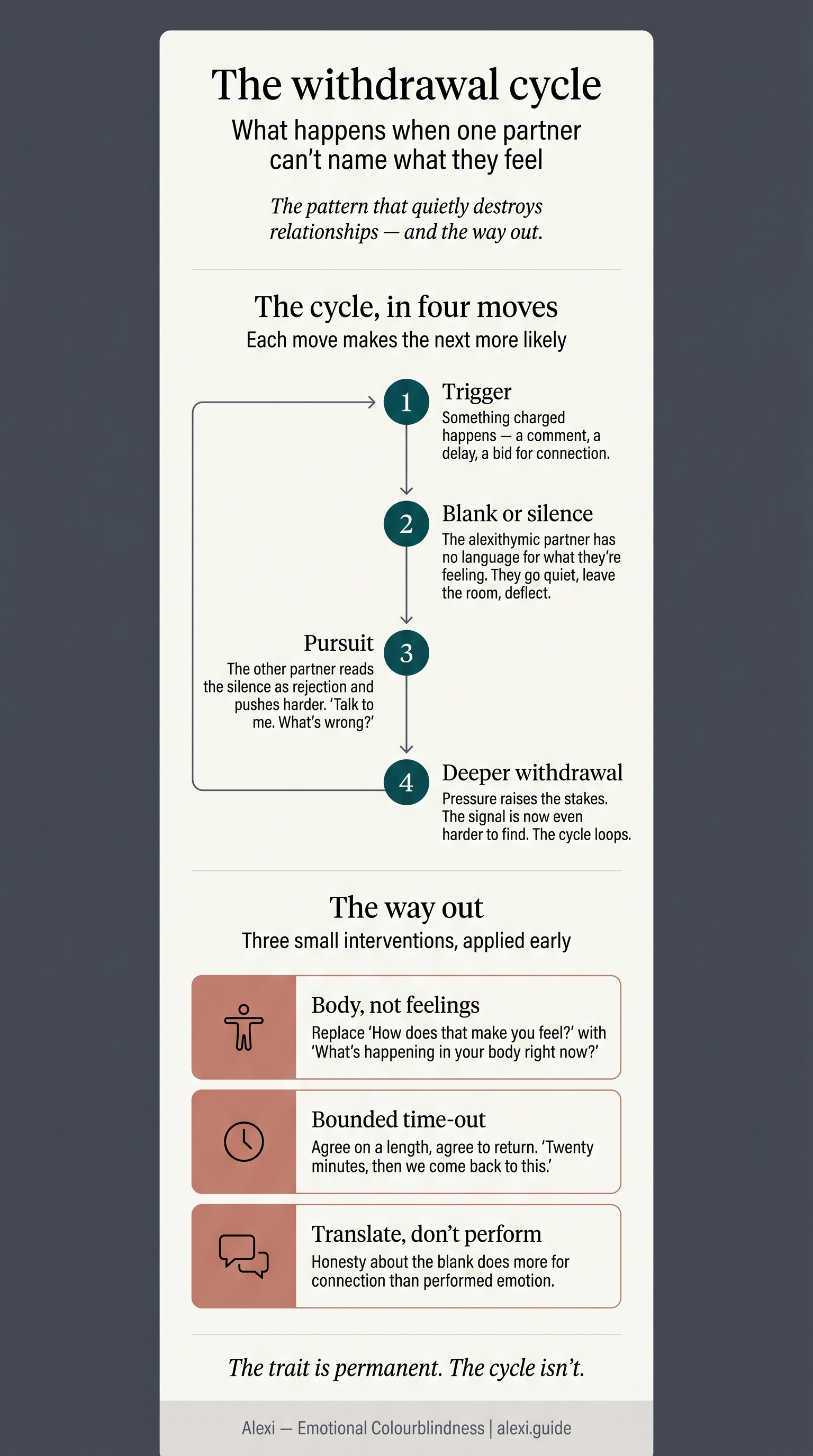
The pattern at the heart of most struggling alexithymia in relationships has a name in couples-therapy literature: pursuer-distancer. You sense distance and ask a question. The question is too direct, too abstract, too soon. Your partner shuts down — not strategically, but because the system has gone into overload and retreat is the only available move. You read the shutdown as withholding and ask harder. The shutdown deepens. By the end of the evening you are alone in different rooms, both certain the other one started it.
What’s happening on their side is something close to flooding. The body is producing a high signal — heart rate up, chest tight, jaw locked — and there is no language to release the pressure. Your pursuit registers, accurately, as more pressure on a system already at capacity. Their retreat is the breaker tripping, not a punishment. This is also where alexithymia and intimacy decay over time — not in the loud arguments, but in the quiet retreats afterwards that nobody finds the words to repair.
The intervention is small and specific. It is not “give them space” — open-ended space reads to the pursuer as abandonment, which is its own kind of intolerable. It is the bounded time-out. A script: I want to keep talking about this. I’m not okay right now. I need fifteen minutes. I’ll come back at 7:30. The numbers are the whole thing. A bounded return time tells the pursuer they are not being left. It tells the distancer they are allowed to step back without choosing between the conversation and their nervous system.
What to do during the fifteen minutes is not rehearse the fight. The alexithymic partner walks, scans the body, drinks water, writes three lines if they can. The other partner does the same. Coming back to the conversation with both nervous systems no longer in alarm is most of the work.
The author remembers a kitchen-bench standoff that ran on for an hour because nobody had the words I need fifteen minutes. By the time anyone did, two days had passed, and none of it was about the original disagreement.
Step 5: Build a shared vocabulary together
This is the practical chapter. There are tools, and they work better than they have any right to.
The feelings wheel. Plutchik’s, Geoffrey Roberts’, any of the common ones. Print it. Stick it on the fridge. Use it as a menu, not a quiz. Point at the closest one is a question an alexithymic partner can usually answer when what are you feeling produces blankness. The wheel is not a deficit-correction exercise — it’s a shared instrument.
Somatic check-ins. A weekly habit: each of you, three minutes, three points. Chest, stomach, shoulders. Rate the tension 1 to 10. Say what shape it is — band, knot, ache, hum. This sounds clinical written down. In practice it becomes intimate quickly. You are reading each other’s bodies aloud.
Scheduled debriefs. Twenty minutes, same evening each week, same opening question. What was the heaviest moment of the week, and where did you feel it? The schedule does specific work for the alexithymic partner — it removes the cognitive load of detecting the right moment, which is itself one of the things they can’t reliably do.
What distinguishes this from therapy homework is that you build the vocabulary together. The partner-reader is not an emotional tutor and the alexithymic partner is not a remedial student. You are both learning a new shared dialect — and many of us don’t actually know where in our bodies our feelings live until someone asks.
For the work the alexithymic partner can do on their own — journalling prompts, interoceptive practice, slow construction of an internal vocabulary — the companion piece on what they can do for themselves goes deeper.
Step 6: Have the meta-conversation
Almost no couple has, explicitly, the conversation about how they have conversations. You should. It is the single most efficient hour you can spend on this.
A script for opening it: I’ve been reading about something called alexithymia. I’m not diagnosing you. I’m not building a case. I want to ask whether some of this lines up with how you experience our hard conversations — whether the question “how do you feel” actually lands somewhere, or whether it just produces static.
What this does, structurally, is replace you are failing me with we have a shared problem with a shape. The alexithymic partner, who has spent years interpreting every emotional question as an indictment, now has a frame in which it is not personal failure. The partner-reader, who has spent years interpreting silence as withholding, now has a frame in which it is not contempt. Same facts, different room.
What to ask, once you’re in the conversation: When I ask how you feel, where does it land in your body? What would make it easier? What should I stop doing? The last question is the most important one. There is almost certainly something — a tone, a timing, a posture — that drops them straight into shutdown, and they likely know what it is.
What not to do: bring this up mid-fight, present it as a diagnosis, or store it as evidence for the next argument. The conversation is a tool for both of you. It stops working the moment one of you is using it as a weapon.
The Emotional Colourblindness guide is two guides in one. Guide Two — For Those Who Love Someone Who Does — was written for the position you’re in right now. It goes deeper into the withdrawal cycle, the scripts for the meta-conversation, and the questions the rest of this article didn’t have room to answer. Read more.
Step 7: Decide what you can and cannot do alone
Two honesties to close on, because anything less is a disservice.
The first: alexithymia rarely resolves. It is not a phase or a wound that closes. The trait can be lived with — well, even — but it doesn’t typically dissolve. People who tell you their partner became fluent in feelings after eighteen months of journalling are usually telling you something else: the partner became fluent at naming the trait, scripting around it, letting their actions be read more accurately. That is enormous. It is also not the same as the trait disappearing. This matters most for alexithymia and marriage, where the time horizon is long and misset expectations compound.
The second: there is work you cannot do alone. If the cycle has been entrenched for months, if resentment is building, if intimacy is hollowing out, a couples therapist who actually understands the trait is worth more than another six months of trying harder. Most therapists don’t know alexithymia by name and will treat the alexithymic partner’s silences as resistance, avoidance, or attachment injury. None of those readings are useful. Look for a therapist comfortable with EFT (Emotionally Focused Therapy), IFS, or somatic-informed approaches. Ask in the first session what they know about alexithymia. If the answer is vague, keep looking.
A red flag worth naming: any therapist who frames your partner as avoidant or in denial without first asking whether they can locate emotion in the body. Avoidance is a strategy. Alexithymia is a capacity issue. Treating one as the other will set you back a year.
What you cannot do, ever, is make them want to do this work. The trait can be navigated; the motivation has to be theirs. If they will not name it, engage with it, or meet you partway, that is a different conversation — and not one this guide can have for you.
What you can do is most of what this article has already named. Most of the alexithymia in relationships that survive are not the ones where the trait went away. They are the ones where both partners stopped pretending it wasn’t there.
FAQ
Is dating someone with alexithymia worth it?
Probably the wrong question. The trait isn’t the variable that decides. Honesty about the trait is. A relationship in which both of you can name what’s happening — I’m asking for an emotional response and I know it’s hard for you to produce one; I’m trying to give you that response and I know it doesn’t always come out right — works. A relationship in which the trait is denied, or weaponised, or used as a wall, doesn’t. The question to ask before is it worth it is can we both name what’s actually here?
Can a relationship survive alexithymia?
Yes, and many do — well. What kills these relationships isn’t the trait. It’s the slow accumulation of misreadings: actions read as indifference, silences as contempt, problem-solving as dismissal, time-outs as abandonment. Each misreading is small. The pile is not. Survival depends on stopping the misreading, not on changing the underlying signal pipeline.
How is alexithymia different from being emotionally unavailable?
Capacity versus choice. Emotional unavailability is a defended choice — the signal arrives, and it is refused at the gate. Alexithymia is upstream of choice — the signal doesn’t arrive in language at all. The shape of the not-knowing tells you which you’re looking at. I’m not going there with you sounds different from I genuinely don’t know what’s happening inside me. They can co-occur, and a person can use alexithymia as cover for unavailability — but the underlying pipeline is genuinely different, and the responses that work are different.
Should I leave my alexithymic partner?
This guide will not answer that for you, because it shouldn’t. What it will say: the trait is not, on its own, grounds for leaving. Refusal to acknowledge it, weaponisation of it, abuse, coercion — those are. If safety is the question you’re really asking, alexithymia is not the lens to use; please use the crisis resources in the opening note above and the lens that fits the actual question.
Will my partner ever say “I love you” and mean it?
The mean it is doing all the work in this question. They likely already mean it — through the dishwasher, the punctuality, the petrol, the small things that have been there all along that you have been counting too lightly. The words may always feel a little rehearsed to them. That doesn’t make the words false. It makes them effortful — produced against a current rather than carried by one — which is, if you re-read it, its own form of love. Possibly a more deliberate one than the easy version.
If you’re navigating this with someone, the guide was written for both of you.