You scored high on the test. You read the explainer, recognised yourself in three sentences out of four, and closed the tab in something that wasn’t quite relief and wasn’t quite grief. Now you’re searching for the next page — the one that tells you what to do.
Most of what comes up uses the word alexithymia treatment. Therapist directories. CBT clinics. Listicles of modalities. Each page implies, without quite saying it, that there is a thing wrong with you that another thing — the right modality, the right clinician — will correct. We want to take the word treatment off the table early. Alexithymia is a trait, not a disorder — like introversion. Roughly one in ten people. Significantly underdiagnosed. You don’t treat being introverted; you learn the language for living with it. The work that follows is the same kind of work.
This article is informational, not a diagnosis. If you haven’t done the screening yet, the test guide is here and the pillar explainer is here. If you’re sitting with the harder edge of this — the “I don’t feel anything” register that sometimes shades into something heavier — please reach out. Lifeline (Australia) 13 11 14. Samaritans (UK) 116 123. 988 (US/Canada). The work below is for steady ground. Get to steady ground first.
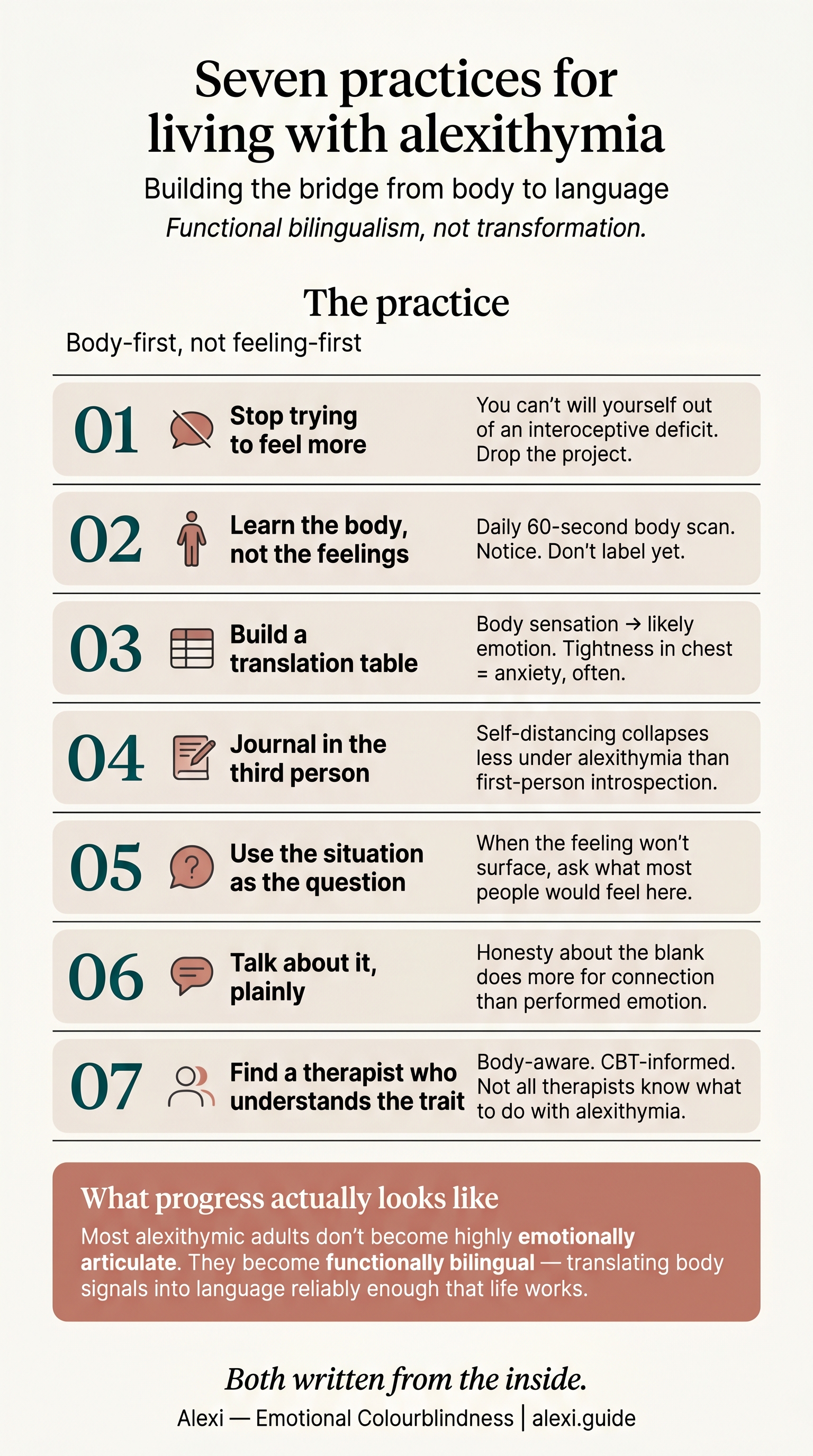
What’s coming: seven practices, written from the inside. Body-first, because that’s the order things actually arrive in. Honest about ceilings, because that’s the only way the practice earns trust. The goal isn’t to become someone whose feelings flow easily into words. The goal is functional bilingualism — translating the body’s signals into language well enough that you can describe them to a partner, a therapist, or yourself.
Step 1: Stop trying to feel more
You’ve probably spent years trying to dial up emotion. Trying harder before therapy. Trying harder during it. Trying harder when a partner asked, again, what you were feeling and you said I don’t know and watched their face go a little tight. The instinct is to push.
The instinct is wrong. An interoceptive deficit is the one thing willpower does not solve — and the dominant model of alexithymia in current research, since Quattrocki and Friston’s 2014 reframing, treats it as fundamentally interoceptive. The signal that tells most people what they’re feeling, why, and what to do with it doesn’t arrive, or arrives as static. No amount of squeezing your eyes shut and concentrating produces a clearer signal from a quieter receiver. You can’t try yourself out of this.
What to do today: stop opening with what am I feeling. Open with what’s happening in my body. That single substitution is the first move of every practice that follows.
Step 2: Learn the body, not the feelings
Interoception is the internal sense of bodily state — the same channel that tells you you’re hungry, thirsty, or about to need the bathroom. For many alexithymic readers it’s quieter than it is for most people. Quieter, not absent. The signals are there; the volume is low and the labels haven’t been wired up.
Sixty seconds, once a day. Sit somewhere you won’t be interrupted. Move attention slowly through the body in this order: head, jaw, throat, chest, gut, hands, legs. At each station, register one of: tension, temperature, weight, restlessness, breath pace. Don’t name a feeling. Don’t try to interpret. Tightness across the chest. Jaw locked. Hands cold. That’s the entire output.
The instruction not to label is the part most readers skip. They read “body scan” and assume the goal is to translate sensation into emotion right there in the chair. That’s a later move. The first move is just to notice that there’s something to notice — that the body is, in fact, broadcasting, and you have spent most of your life with the volume turned down.
Do this every day for a week before you go anywhere near Step 3. Most people who try to skip ahead end up with a translation table that maps nothing to nothing.
Step 3: Build a translation table
Here is the practice that compounds. Open a notebook. Three columns: BODY, SITUATION, BEST GUESS.
When you notice a body signal — and you will, now, because you’ve been listening for a week — write down what’s happening in the body, what’s happening around you, and your best guess at the feeling. The third column is allowed to say no idea. Often it will. That’s not failure; that’s the data.
Three examples from a real translation table:
- Chest tightness, slightly fast breath. In a meeting where my manager interrupted me twice. Best guess: anxiety, maybe also annoyance.
- Hot face, ears burning. Friend made a joke at my expense in front of others. Best guess: shame.
- Foot tapping for an hour, can’t settle. Saturday afternoon at home, nothing scheduled. Best guess: under-stimulation, possibly low-grade restlessness or boredom.
A feelings wheel — Plutchik’s, or any of the variants you can find online — is useful here as a vocabulary list. Not as a diagnostic tool. Use it the way you’d use a thesaurus: to find a word for something you’ve already noticed, not to manufacture a feeling you haven’t.
Over weeks, patterns emerge. Chest tightness in meetings maps reliably to one thing. Heat behind the eyes maps to another. The translation table is your personal lexicon — built from your body, not someone else’s. This is the work. Most other practices in this article exist to feed it.
Step 4: Journal in the third person
First-person introspection — what am I feeling, what do I think about this, where is this coming from — collapses under alexithymia. The signal isn’t there to introspect on. You sit down to write I felt and produce two sentences that are mostly weather and what you ate.
Try it from the outside. He was tense at the dinner. He left earlier than the others. On the drive home he kept replaying one comment. Third person is narrative scaffolding. It lets you describe the behaviour and the situation without requiring direct access to the interior. Often, the description itself surfaces what the introspection couldn’t.
The broader self-distancing literature (the line of research associated with Ethan Kross and colleagues) finds that observing yourself from outside reduces emotional reactivity and improves problem-solving. For alexithymic readers the gain is different but real: third-person writing produces narrative coherence where first-person produces blanks. You end up with a record of yourself you can reread later — and rereading old third-person entries, with a week or a month of distance, sometimes lets you name what was going on at the time.
The prompt: tonight, write three sentences about your day in third person. Not as a creative exercise. As a description of someone you happen to be inside.
Step 5: Use the situation as the question
When the body isn’t reporting and you still need an answer, there’s a useful trick from the alexithymia literature itself. Bermond, Vorst, and Moormann’s distinction between Type I and Type II alexithymia maps the territory: Type I is both affective and cognitive deficit; Type II is cognitive access without affective access. The Type II reader can reason about emotion — knows, in the abstract, what a person should feel in a given situation — but doesn’t feel the feeling arriving. Most readers of this article are somewhere on that spectrum.
This is usable. When what am I feeling returns nothing, ask what would most people feel here? Friend cancelled plans last minute: most people would feel disappointed, maybe a bit hurt. Praised in front of the team: most people would feel pleased and slightly self-conscious. Partner came home late without messaging: most people would feel anxious and then annoyed.
This isn’t faking. It’s borrowing the map until your own arrives. You take the most-people guess, hold it next to what’s happening in your body (Step 2), and check whether they line up. Often they do — the chest tightness is the disappointment, you just hadn’t connected them. Sometimes they don’t, which is its own information: maybe what you actually feel is something other than the standard-issue response, and that’s worth knowing too.
This step is the bridge between the cognitive scaffolding most alexithymic readers already have and the body-first work the previous steps installed. Use it as a working hypothesis. Check it against the body. Update.
Step 6: Talk about it, plainly
Years of being asked what are you feeling? and producing genuine blankness teaches a particular kind of performance — the small false answers that keep the conversation moving. I’m fine. A bit tired. Just thinking. The performance is exhausting and it doesn’t fool anyone for long.
The alternative is the quiet, structural sentence. I don’t always know what I’m feeling. I might need a day. I’m not avoiding you. Said once, to a partner, a friend, a therapist — not as a confession or a label, just as information. People adjust when they understand. The withdrawal that looked like indifference becomes legible as a processing delay. The blank stare becomes a known feature, not a personality flaw.
Honesty about it does more for connection than any amount of trying to perform emotions you don’t have access to. The performance buys five minutes; the honesty buys the relationship. (For partners reading this article, or for the version of this conversation that has to happen across a kitchen table on a difficult evening, the field guide for relationships goes deeper.)
This is the step that sounds easiest and is often the hardest. It requires giving up a strategy that has, in some sense, worked — the small false answers have kept you in jobs and friendships and beds. Replacing them is slow. But every plain sentence you say out loud makes the next one easier.
Step 7: Find a therapist who actually understands the trait
Most therapists don’t. The standard training treats difficulty naming feelings as resistance, avoidance, or attachment-related defence — something to be worked through by talking more carefully about feelings. For alexithymic clients this often makes things worse. You sit in the chair, you’re asked what’s coming up for you, and the honest answer is nothing is coming up, and the room gets quieter and nobody is helped.
What to look for in alexithymia therapy, in order: someone who knows what alexithymia is without you having to explain it; someone comfortable with body-first work (somatic, sensorimotor, polyvagal-informed, mindfulness-based — the names vary, the orientation is the same); someone CBT-informed enough to do behavioural and cognitive work, not insight-only. The Bagby, Parker, and Taylor research underlying the TAS-20 has been around since 1994. A clinician who looks blank when you say Toronto Alexithymia Scale is probably not your match.
One nuance worth raising in the first session: primary versus secondary alexithymia. Primary is the trait — lifelong, structural, what most of this article addresses. Secondary is alexithymia that arrives as a response to trauma or chronic illness; the practice is similar but the therapeutic stance is different (slower, more attention to the trauma layer first). A clinician who treats both the same is missing something.
If your current therapist is good but doesn’t know this material, you can hand them a copy of any of the explainers. Most decent clinicians update fast when given language they didn’t have.
If you’ve made it this far, you might be ready for the longer version. Emotional Colourblindness is the two-guide PDF the author wishes had existed before twelve months in weekly sessions with a research psychologist who never named the trait. Guide One — For Those Who Live With It is the deeper version of the seven practices above. Guide Two — For Those Who Love Someone Who Does is the conversation in the other direction, written for the partner. Both written from the inside. Get the guide →
What doesn’t work (and why so much “alexithymia treatment” advice misses)
Most alexithymia treatment advice on the open web assumes you can access feelings if you try harder. Once you see the assumption, you see how much it disqualifies.
A generic feelings journal — name three feelings each evening — fails because the access isn’t there. You sit down at 9pm with the page open and produce tired, fine, okay, which is what you produced last night. The journal becomes evidence of failure rather than a tool. The fix is the translation-table version above: start with the body, end with the best-guess feeling, allow no idea as a legitimate entry.
Insight-only talk therapy fails for the same reason. What comes up for you when you think about that? assumes a coming up that, for the alexithymic client, is exactly what’s missing. Without a body-first or behavioural component, the sessions can run for years and produce a more articulate version of the same blankness.
Sit with the feeling fails because there isn’t a feeling to sit with — there’s a body signal you haven’t yet learned to read. Mindfulness in its richer form (paying attention to sensation rather than to thought) is genuinely useful, and is essentially what Step 2 is. Mindfulness reduced to “notice your emotions without judgement” is not, because it presupposes a found emotion to notice.
Feelings wheels deployed without the body-mapping step become decorative. Plutchik’s wheel is a beautiful artefact and a real vocabulary aid, but pointing at it and asking yourself which of these am I feeling right now? tends to return either nothing or a guess pulled from the social context rather than the body. The wheel works as a thesaurus for sensations you’ve already located, not as a diagnostic instrument.
This isn’t a takedown of the field. CBT, mindfulness, and journalling all have a place in living with alexithymia — they just have to be sequenced correctly, with the body first and the language second.
What progress actually looks like
Most alexithymic adults don’t become highly emotionally articulate. The change is quieter than that.
What you can reasonably expect, after a year or two of consistent practice: a working translation table that catches most of your common states. The capacity to say, in real time, I’m feeling something here, give me a minute rather than going blank and saying nothing. A partner who knows what to expect and stops asking the question that always produced silence. A therapist you can actually use, doing work that goes somewhere. The slow, unglamorous accumulation of self-knowledge — most of it phrased in body language before it makes it into emotion language.
Researchers like Preece and colleagues, in developing the Perth Alexithymia Questionnaire, distinguish between state and trait alexithymia: the underlying trait is stable, but state — how alexithymic you’re being on a given day, in a given context — moves. Stress, sleep, illness, social load, all push state up. Practice and steady ground push it down. You’re not aiming to change the trait. You’re aiming to live in a lower-state version of it most days.
A version of the milestone that comes up in lived-experience writing more than any other: I no longer hide it. The people close to you know. Your therapist knows. You know. The energy that used to go into the small false answers goes into the actual work. That, more than anything, is what living with alexithymia ends up looking like — not a fixed self, but a self you no longer have to perform around.
You spent years not knowing there was a name for this. You don’t have to spend more years not doing anything about it. But the doing is not the hectic project the word treatment implies. It’s a slow, body-first practice — sixty seconds at a time, three columns at a time, one third-person sentence at a time.
FAQ
Can alexithymia be cured?
No, because alexithymia is a trait rather than a disorder — closer to introversion than to depression. The trait itself is stable across life. What changes, with consistent body-first practice, is state alexithymia: how much the trait disrupts you on a given day. Most people who do the work don’t become highly emotionally articulate; they become functionally bilingual, translating body signals into language reliably enough to live well. That’s the realistic outcome, and it’s a meaningful one.
Does therapy help alexithymia?
The right kind, yes. Look for a therapist who is somatic-aware (comfortable with body-first work), CBT-informed (so the work is behavioural as well as reflective), and familiar with the trait itself — ideally able to discuss the TAS-20 or Perth Alexithymia Questionnaire without you having to explain. Insight-only talk therapy that opens with what comes up for you tends to stall, because the coming up is precisely what alexithymia interferes with. See Step 7 above for the full breakdown.
How long does it take to develop emotional vocabulary?
Months for the first noticeable shifts (a working translation table for your common states); a year or two for the deeper changes (catching feelings in real time, talking about them plainly, no longer performing). The work compounds slowly and isn’t linear. You’re not aiming for native fluency in someone else’s emotional language; you’re aiming for functional bilingualism in your own.
What’s the best self-help approach for alexithymia?
The most reliable alexithymia self-help routine is three practices, layered in this order:
- A daily 60-second body scan (Step 2) — the foundation everything else sits on.
- A translation-table journal mapping body signals to situations and best-guess feelings (Step 3) — the practice that compounds.
- Third-person journalling a few times a week (Step 4) — for the entries first-person can’t reach.
Add a feelings wheel as a vocabulary aid, not a diagnostic tool. Avoid generic feelings journals that ask you to name emotions cold — they tend to fail in ways that erode the practice.
Will medication help alexithymia?
There is no medication for alexithymia itself — no drug targets the trait. Medication can help with co-occurring depression, anxiety, ADHD, or PTSD, all of which commonly sit alongside alexithymia and all of which can interfere with the bandwidth needed to do the practice. If a co-occurring condition is making the body-first work impossible, treating it can free up the ground the practice needs. Speak to a GP or psychiatrist; this article is not medical advice.
Both written from the inside. Get the guide.